
Thursday, June 18, 2026
Fairfax County was a hotbed of revolutionary zeal in the 1700s. July 4th will mark 250 years after the Continental Congress voted to ratify the nation’s Declaration of Independence in 1776, but three weeks earlier, on June 12, the Virginia General Assembly ratified the Virginia Declaration of Rights authored by George Mason IV of Gunston Hall. Even before that in 1774, George Washington and primarily George Mason wrote the Fairfax Resolves, resolutions rejecting Britain’s authority over the colonies.
Gunston Hall celebrated Declaration Day on June 13, with several “returning patriots” offering insights into the events and philosophy of the rebellious colonists who fomented a revolution against British rule.
The Declaration of Rights
“Thomas Jefferson” told a rapt audience, “George Mason was one of the greatest minds I have ever met.” The Virginia Declaration of Rights is considered by many to be the first clear statement of principles of the new democratic government. The first article of the Declaration begins, “That all Men are by nature equally free and independent, and have certain inherent rights.” The document affirms other rights such as “the
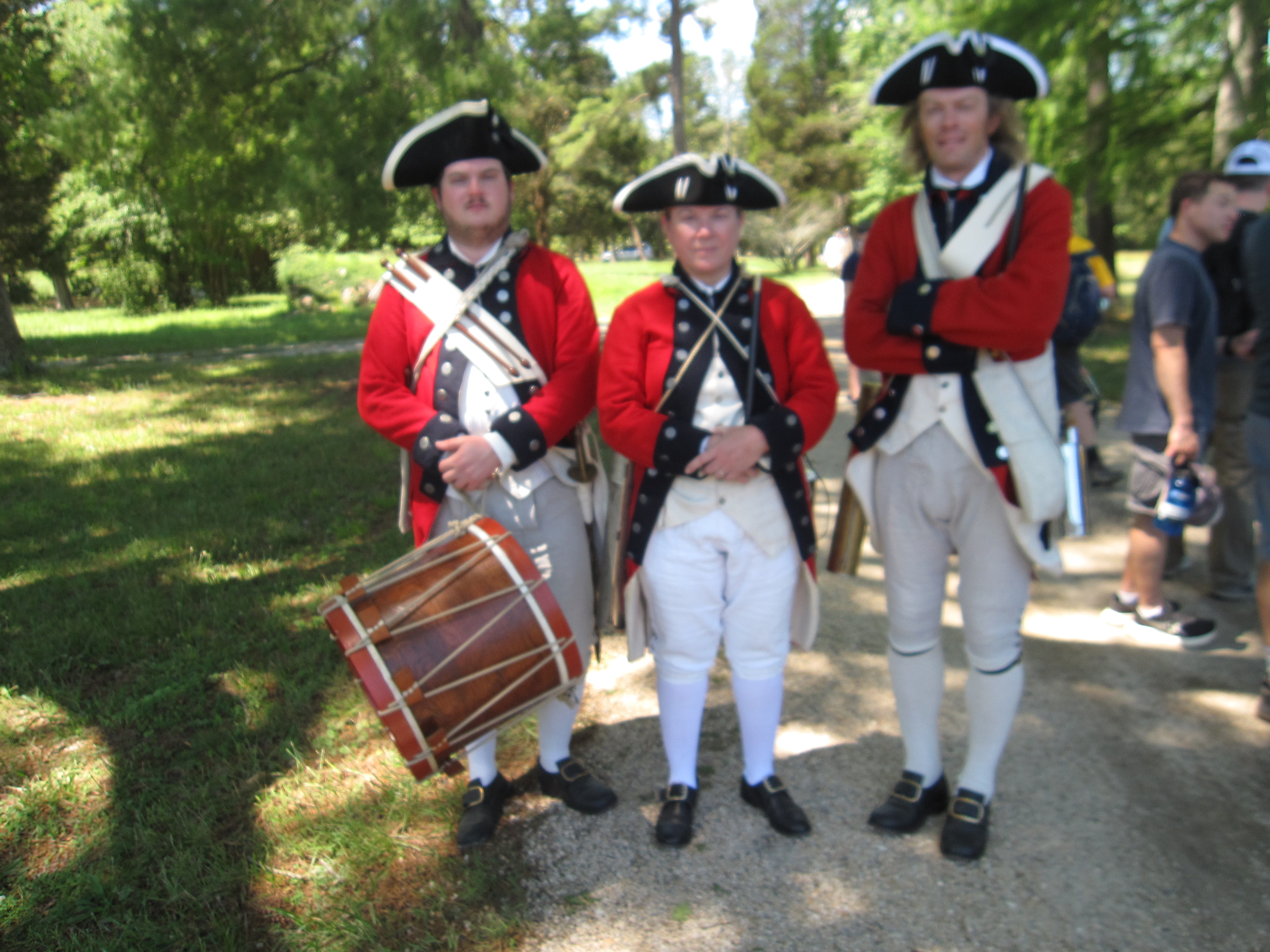 The Old Line Fife and Drum Band sustains colonial music. Left to right: Daniel Wilson, Michelle Wilson, Ben Squier.
Doug Thomas, portraying Washington, and Steven Edenbo as Jefferson, had a lively conversation about the origins of America’s government and the drafting of its founding documents. Washington stressed that the Constitution is a “living, breathing document,” and its chief feature is that it can be amended by the people, “not by usurpation.”
“A monarch governs by fear,” said Jefferson. “A democracy governs by virtue,” adding, “We need an informed public so you can hold your leaders accountable.”
“How long did it take to write all this stuff?” asked an alert adolescent to audience snickers.
Washington answered, “the Constitution, the summer of 1787.”
On the Declaration of Independence, Jefferson responded, “Two and a half weeks and I did not wait until the night before it was due,” a comment that elicited laughter.
Rozalyn Gaines, as Nell, an enslaved woman, reminded people, “Change is hard. If something is unfair, the question is, how do you make it fair?”
The day began with the Sons of the American Revolution laying a wreath on the Masons’ tombs in the family graveyard. Visitors toured the mansion, built between 1755 and 1758, and enjoyed a birthday cake.
Activities and Partners
A three-member Virginia women’s group, The Itinerant Band, entertained with pre-Revolutionary War music of the colonies, playing a flute, fiddle, recorder and guitar. Some of their songs are still played today, one said, like “Soldier’s Joy” and “Greensleeves.”
Children played 18th century games, like ring toss with rings made of twine and made tri-cornered hats and cockades.
April Carter made buttons with messages like “freedom of the press” and “Declaration of Rights.” Visitors tried a “Rights Advocates Matching” game, by turning over cards with photos of American figures like Cesar Chavez, Ida B. Wells and Jackie Robinson.
Along the magnolia-lined lane to the brick Georgian mansion, organizations touted their mission, including George Mason University, the Library of Virginia, the National Museum of the Marine Corps and Fairfax County libraries. Women of the National Society of the Colonial Dames of America said they trace their ancestors to the colonies.
Keil Gentry, Director of the Marine Corps museum said, “We’re here to celebrate the country’s anniversary through the eyes of the marines. The Marine Corps’ founding date, Oct. 10, 1775, coincides with the nation’s.”
On June 12, Gunston Hall hosted a naturalization ceremony for 48 people from 22 countries. The guest speaker was Jorge Zamanillo, founding director of the planned Smithsonian National Museum of the American Latino in Washington, D.C.
Saturday’s guests enjoyed a little 18th century humor too when Jefferson asked some youngsters from Annandale Cub Scout Pack 855, “What is my favorite tea?” The answer: Lib-er-tea.